


Antonio Díaz and Dawn Curtis share a common vision: a future when their neighbors are thriving in healthy, resilient homes, schools and workplaces, and benefiting from a green economy. Díaz and Curtis are also both part of Community Climate Shift, an initiative working for equitable emissions reduction and community-driven policymaking.
Begun by the People’s Climate Innovation Center (Climate Innovation) and the Institute for Market Transformation (IMT), Community Climate Shift works to ensure that decarbonization of the built environment is led by — and meets the needs of — communities on the front lines of climate change.
“Immigrants and low-income communities of color experience the health impacts of the climate crisis first and worst,” says Díaz, director at PODER San Francisco, an environmental justice organization. “But they also know what is needed to solve these challenges.”
These challenges include unprecedented natural disasters, high utility bills and unhealthy air — all of which are connected to the 74% of U.S. electricity used by the built environment. What’s more, most people spend 90% of their time inside buildings, making them tremendously important for health, safety and stability.
The Biden administration formed the National Building Performance Standards Coalition to encourage local and state governments to set policies that improve existing buildings. Paired with the Building Infrastructure Law and Inflation Reduction Act (IRA), this presents an unprecedented opportunity to decarbonize the built environment through investments in energy efficiency and clean energy. But it is not guaranteed that those investments will benefit those who need them most.
“Historically, underserved communities have been marginalized or eliminated in decision-making affecting the built environment,” says Curtis, who serves as Environmental Justice Chair for the NAACP and as founder of Grassroots Impact in Orlando. “We believe by improving the energy efficiency of these ignored structures, our communities could experience a financial reprieve and improved health conditions.”
Philanthropy’s big opportunity to back a climate justice movement
The new wave of federal funding could spur needed change, but could also perpetuate harm to historically marginalized communities. Unless they are part of decision-making, residents could be shut out of game-changing cost savings, job opportunities and health benefits. Conversely, philanthropy has a multimillion-dollar opportunity to leverage federal investment to give front-line communities a leading role in developing and implementing policies and programs.
Making the most of this moment requires backing a movement. This movement must be community-led, partner-rich, and it must shift power to the people experiencing climate change first and worst. Enter Community Climate Shift: a collaboration of local community-based organizations and national environmental nonprofits working to ensure residents have the resources and connections to drive their own solutions.
This initiative provides financial, strategic and tactical support from a network of partners to better equip community-based organizations to collaborate with local governments and to access federal funding. These efforts will build long-term capacity for participating organizations and offer an innovative, scalable policymaking model.
This video outlines the initiative’s unique approach.
This concept is gaining traction. In July, the Department of Energy awarded $5 million to IMT and many of the Community Climate Shift team members to support state and local governments taking this approach to building improvement policies. Due to onerous federal reporting requirements, funds for community organizations must be raised separately. Thanks to seed funding from The Kresge Foundation, the Energy Foundation and the Waverley Street Foundation, collaborative relationships between government and community are already producing results.
“When I think about the incredible challenge before us to solve the climate and equity crises, I cannot think of a more promising through-line than Community Climate Shift,” said Sierra Martinez, former Energy Foundation policy program director.
San Francisco: Scaling up retrofits, equitably
Advancing equitable building decarbonization — improvements to buildings that remove fossil fuels and increase the efficiency and health of buildings — is a continuation of work that PODER has been doing to improve the health and lives of Latinx immigrants since 1991.
PODER is partnering with the City of San Francisco and Emerald Cities Collaborative, a nonprofit focused on building high-road economies, to launch an equitable decarbonization pilot project in San Francisco’s Mission District. The goal is to determine what infrastructure is needed for San Francisco to both reach its carbon reduction goals and advance equity. PODER is pairing Community Climate Shift funds with those from the City’s Department of Environment to evaluate potential sites and incorporate complementary strategies such as high-road contracting, electrification, and possibly local energy production. As part of this project, PODER will hire policy staff to advocate locally and participate in statewide environmental justice policy discussions.
PODER intends to expand the work to cover a full city block, and bring this model to neighborhoods across the city. This will have widespread impact. Buildings contribute to approximately 40% of San Francisco’s overall greenhouse gas emissions. More than 80% of the local housing stock was built before 1980, making these structures more likely to waste energy and increase residents’ utility expenditures. These older buildings also present health hazards like mold, lead and asbestos that can be addressed through building improvement.
Scaling community-led policymaking
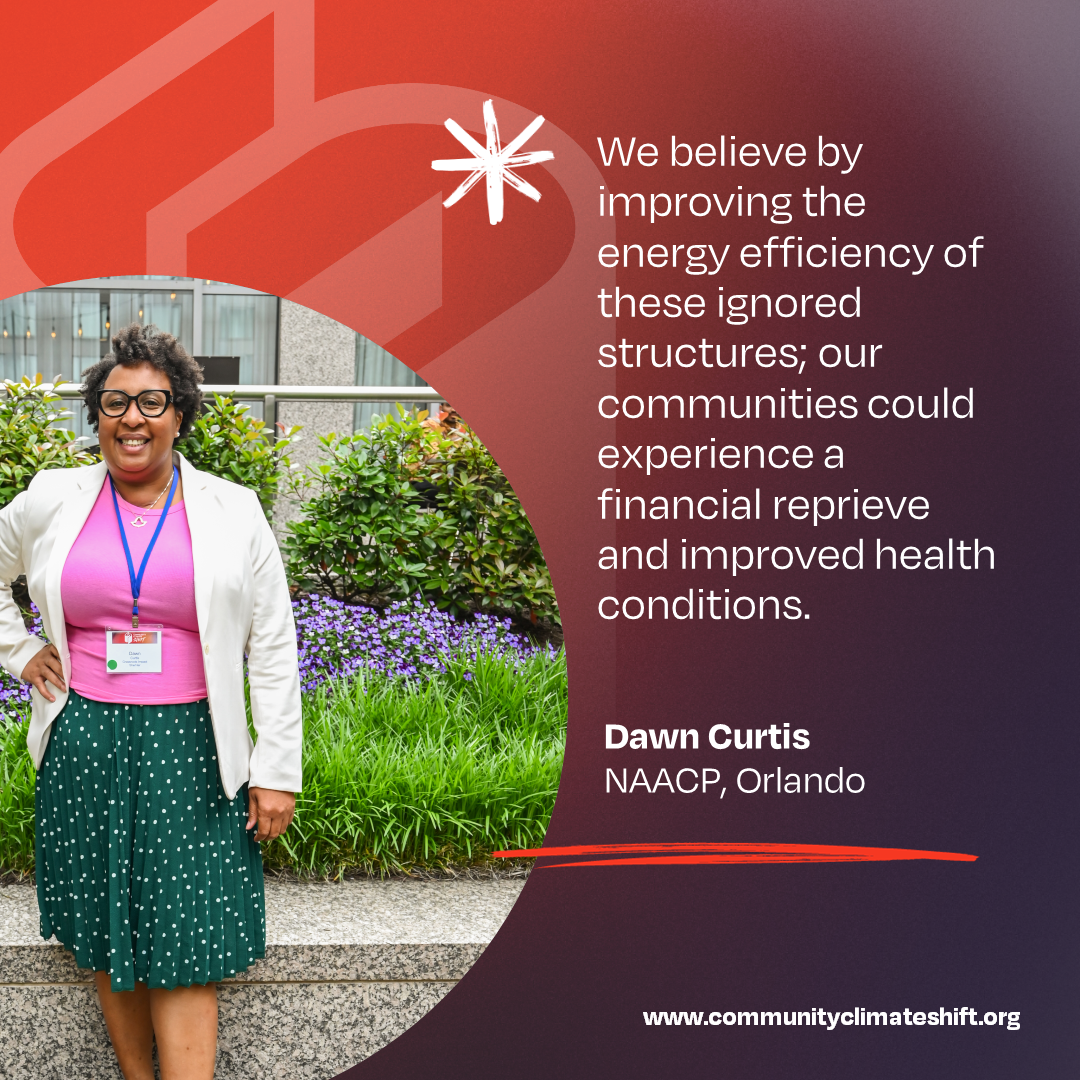
Community organizations have the deep relationships needed to effectively communicate with front-line community members and identify their priorities. In Orlando, Community Climate Shift is supporting Dawn Curtis’ work with Central Florida Jobs with Justice and Grassroots Impact on the Orlando Climate Forward campaign. Their goals include energy justice, reducing energy burden for front-line communities, and increased community ownership over climate solutions in the Greater Orlando area.
Curtis visits residents in their homes to talk about energy security, weatherization challenges and policy approaches that could improve buildings across the city. At the same time, Curtis conducts an inventory of living conditions, providing valuable data for policymaking, while developing a broader understanding of the conditions of residential housing in Orlando’s front-line communities.
Learn more about Dawn Curtis’ work in this video.
Lasting policy wins
Community Climate Shift embraces the idea of “going slow to move fast.” That means giving those closest to the challenges the opportunity to shape building decarbonization strategies and win broader, more sustained support. This initiative seeks to fundamentally reconcile relationships and power dynamics between governments and community organizations so that they can address challenges collaboratively now and in the future.
Current federal funding presents a once-in-a-generation opportunity to shift power to front-line communities. By investing in Community Climate Shift, funders can leverage federal resources to benefit the people who need them most, while building the infrastructure for a movement that will endure long after funding has been spent.
As Jessica Boehland, Kresge Foundation senior program officer, put it, “CCS is already built. The partners in place. All that’s needed is the funding.”
Lotte Schlegel is Executive Director at the Institute for Market Transformation. Corrine Van Hook-Turner is Director at the People’s Climate Innovation Center.
