


In today’s new Gilded Age, American women and girls are facing threats to a broad spectrum of rights and protections that have existed for decades. Abortion access is under attack, and birth control is increasingly at risk. So is women’s ability to apply for credit without a male relative’s signature. Federal contractors are now free to discriminate against women as well as LGBTQ people, racial minorities and those of differing (or no) religion. There’s even some who doubt as to whether the administration’s defense secretary supports women’s right to vote, though the Pentagon has denied this allegation.
Simultaneously, we’re also living in the era of the female billionaire. In September, Forbes published a list of the 10 wealthiest American women this year, those whose net worths range from $27.4 billion to $106 billion. And those were just the top 10: According to Forbes, there are 62 women among the 400 wealthiest people in the country today — and every one of those women is a billionaire. In what could be argued is a triumph for gender equality, more than half of today’s female American billionaires are self made, either by themselves or with their spouses.
But even with the significantly greater constraints women faced 100 years ago, some were able either to create their own fortunes or build significantly on their inherited wealth. America’s first self-made woman millionaire was Madam C.J. Walker, a Black woman. The “Witch of Wall Street,” Hetty Green, was a financier who built an inheritance worth $112 million in 2025 dollars into a fortune of $2 billion in today’s money. But despite the fact that women today continue to face professional and economic inequality, it is also true that modern American women — particularly those who start their lives on the more privileged end of the scale — enjoy educational and professional opportunities far beyond even the wealthiest of their peers from the past.
What’s also true is that the wealthy women of our country’s current Gilded Age have more than a few things in common with their foremothers. For one thing, both cohorts are far outnumbered. Forbes counts only 62 women, after all, in the country’s top 400 wealth holders.
Likewise, some mega-rich women from both ages share a propensity for making their dollars heard via philanthropy. The big difference, though, is in the two group’s philanthropic priorities. Mega-wealthy women in the first Gilded Age were passionate about expanding educational opportunities for the country’s girls and women. Most of today’s wealthiest women aren’t focused on the current challenges facing the country’s girls and women at all.
Opening doors: wealthy Gilded Age women focused on women’s education
By 1870, girls were outperforming boys in the nation’s public schools, according to a review of the historic struggle for American girls’ and women’s education in the U.S. by the World Economic Forum. This scholastic success made it harder for the conservatives of the day to argue that women were less intellectually capable. Instead, they switched to claims that education harmed women’s and girls’ health, particularly their ability to get pregnant and give birth. One physiologist mentioned in the article even argued that if young women were to be admitted to Harvard, “the energy required to learn subjects like algebra would flow from other bodily systems, harming their ovaries.”
In response, the era’s wealthy women donors focused on access to education, “especially higher education,” said Joan Marie Johnson, the author of “Funding Feminism: Monied Women, Philanthropy, and the Women’s Movement, 1870-1967.” “I think many women [thought that] education was going to open doors to employment and the professions for women, which was going to improve their overall status in society.”
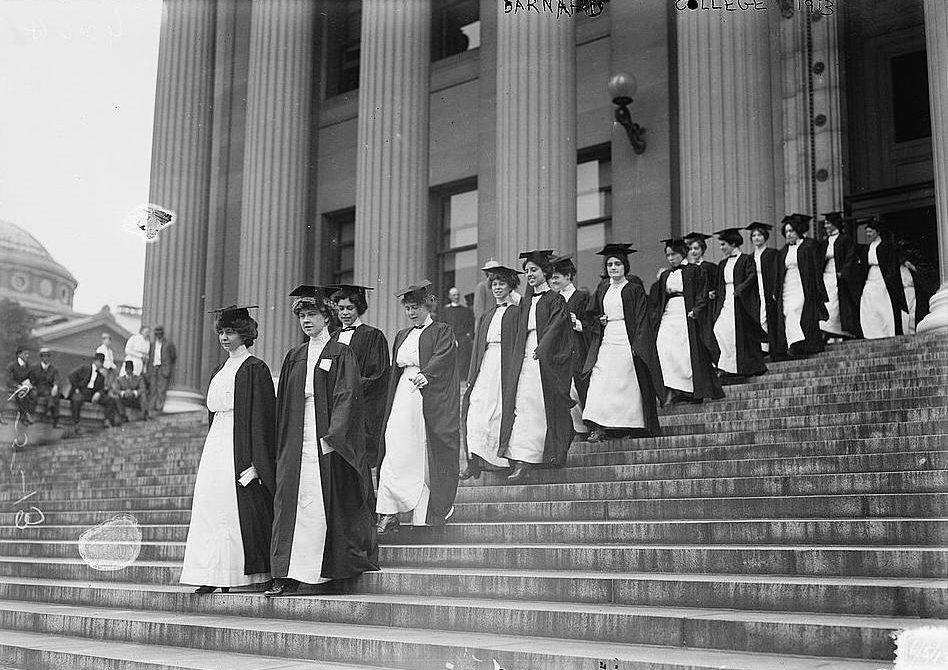
Some wealthy female donors founded elite universities for women. Annie Nathan Meyer founded Barnard College, New York state’s first liberal arts college for women, while Sophia Smith’s will provided the money to launch Smith College, one of the famous Seven Sisters colleges created to allow young women the same degree of educational rigor their male counterparts were receiving in schools like Harvard and Yale. Mary Jane Richardson Jones, who with her husband was a member of one of the first Black families to come to Chicago, used an inheritance from her husband’s successful tailoring business in part to found Provident Hospital. Provident’s services included medical schools for Black nursing and medical students at a time when precious few schools admitted either.
Not all of the era’s women donors were content with separate but equal education. Mary Garrett, whose father owned the B&O Railroad, “is probably the most important example” of women who succeeded in opening up co-ed college education, said Johnson.
“She really resented the fact that her brothers were allowed to get a college education,” Johnson said. “They were allowed to work in the family business. She was not, and so she felt really very strongly about opening up opportunities for education and professions for women.” When Garrett’s father died in 1884, she used part of her $2 million inheritance — the equivalent of more than $66 million today — to found the Bryn Mawr School, a prep school named for the college.
After that success, she set her sights on a more ambitious project: opening up Johns Hopkins University to women. When the school rebuffed their initial offer to back a co-ed school of science at the university, Garrett and her close circle of friends, known as the “Friday Evening,” contributed the lion’s share of the funds that launched Johns Hopkins’ medical school. The money came with strings attached. To qualify for the funds, the university had to agree to accept women on an equal basis and require all incoming medical students to have a bachelor’s degree in science, a leading-edge development at the time.
Modern billionaire women have other priorities
Today, of course, young American women don’t have to fight for a postsecondary education. In 2022, 1.6 million more women than men held bachelor’s degrees. But while education was the fifth-highest priority of donors overall in 2023 according to the Lilly School of Philanthropy’s recently-released 2025 Women & Girls’ Index, MacKenzie Scott and Oprah Winfrey are the only American women billionaires who have made women’s and girls’ education a specific focus in their giving.
Inside Philanthropy’s 2023 summary of the 50 Most Powerful Women in Philanthropy reveals the wide range of interests that today’s women megadonors are supporting with their giving. Those issues include non-gender-specific antipoverty work, the arts, climate action, co-ed education and criminal justice reform. Only five out of the 23 listed megadonors made gender-specific issues a priority. Just two of them, Lynn and Stacy Schusterman, had publicly focused on abortion access via their foundation, the Charles and Lynn Schusterman Family Philanthropies. (The Susan Thompson Buffett Foundation is known as a stealth reproductive health funder.)
Since our 2023 report, of course, Melinda French Gates has become an even more prominent force in women’s and girls’ philanthropy. She had previously backed women’s and girls’ causes through her giving vehicle Pivotal, and supported women globally as a former co-chair of the Gates Foundation. And after leaving Bill Gates and their joint foundation behind her, French Gates committed $1 billion through 2026 for issues including women’s and girls’ health, mental health and reproductive rights. But she was already one of the very few women megadonors supporting other women and girls.
Of course, this doesn’t mean that many of these same donors, or other ultra-wealthy women, aren’t giving to support abortion access, maternal health and other areas under attack or facing neglect by the Trump administration. As Inside Philanthropy’s Michael Kavate has highlighted, it’s difficult to determine how much cash major wealth holders are actually moving to nonprofits. Those who support women’s reproductive and other rights have to hope that billionaires whose friends and loved ones’ rights are only a private jet flight away are giving privately and generously.
Perhaps this seeming lack of interest in women’s and girls’-specific issues arises from a feeling that feminism has “won.” Among many other privileges, vast wealth grants a degree of privacy, autonomy and deference that most American women don’t come close to enjoying. It’s entirely possible, and even understandable, that their vantage point from atop piles of money has somewhat blinded the country’s women billionaires to the threats facing the rest of us. The multiple, overlapping crises in the U.S. and world at large also make a compelling case for prioritizing other issues.
What’s also true, though, is that the wealthy women donors of the 1870s themselves were confronted with the myriad and overlapping issues that were the crises of their day, from significant poverty and racism to radically unsafe food. This didn’t stop them from trying to give other women and girls a hand up. Today’s ultra-wealthy women have significantly more means and social capital at their disposal to do the same. What seems clear is that unless something changes, the country’s non-rich women and girls may reasonably wonder whether the current Gilded Age will see our rights roll back closer to their state when the first Gilded Age began.
Correction: A previous version of this story referred to Bryn Mawr College as the prep school Mary Garrett founded. Garrett founded Bryn Mawr School, a prep school named for Bryn Mawr College.
This piece is part of our special series on billionaire giving in a new Gilded Age. Check out all the articles here.
