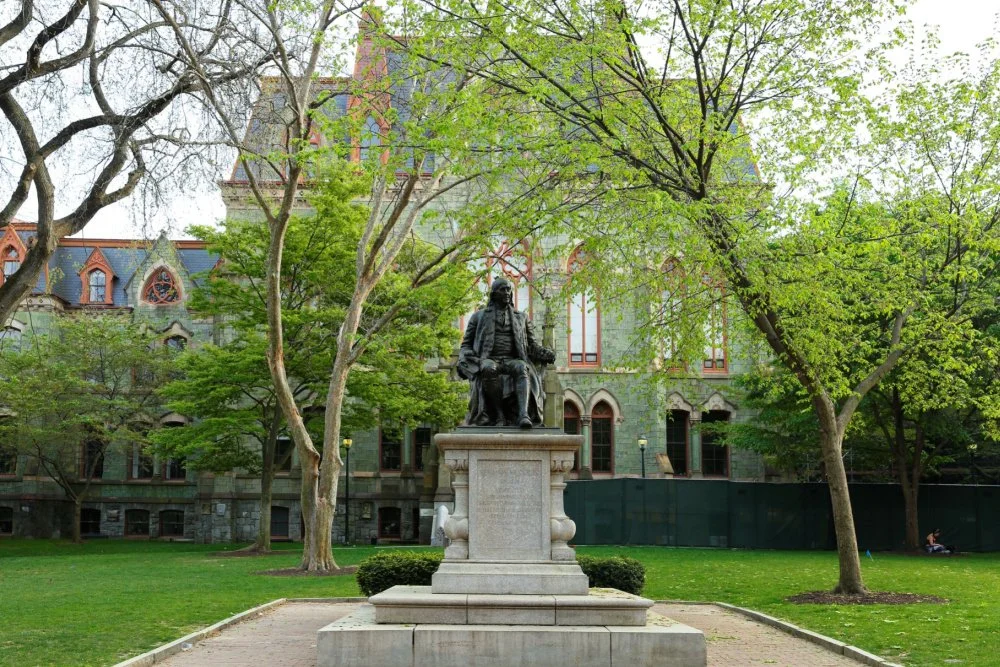
In early November, the New York-based W. P. Carey Foundation gave the University of Pennsylvania’s Penn Law School a $150 million gift earmarked to increase financial support for historically underrepresented students, expand the school’s pro bono program, facilitate the recruitment of scholars, and fund a new alumni lifelong learning program. In recognition of what Penn called the largest donation to any American law school, the board of trustees approved changing Penn Law’s name to the “University of Pennsylvania Carey Law School”—“Carey Law” for short.
In a written response to Inside HigherEd, William P. Carey II, chairman of the foundation, said, “At an institution of Penn’s stature, we felt a large grant would be necessary to achieve all of the plans the Law School had laid out to truly transform the legal education it was providing.” The gift also came a month after a Rockefeller Philanthropy Advisors and TIAA Institute report found that support for “low-income students and students of color to begin and complete a postsecondary degree” was the “dominant” trend across the institutional higher ed fundraising space.
And so, at first glance, news out of Philadelphia fit into a predictable, simple narrative—a funder provides a transformative naming gift aimed at, among other things, supporting underrepresented students. Then again, when is anything truly simple in today’s higher ed fundraising landscape?
After Penn announced the gift, more than 3,000 students and alumni eventually signed a petition demanding the restoration of the school’s old name. “The undersigned would like to preserve the brand recognition, over century-long history, and clear association with the University of Pennsylvania that comes with the name Penn Law,” the petition read. Students and alumni also complained that administrators failed to consult them throughout the renaming process.
The controversy speaks to a growing tension across the higher ed fundraising landscape. Universities—elite and otherwise—are increasingly reliant on private dollars to attract historically underrepresented students, bankroll scholarships, recruit faculty and fund the construction of new buildings. Yet Penn students and alumni came to resent the idea that an opaque funder and an administration acting unilaterally could alter the identity of a key institution in their lives with the stroke of a pen.
Let’s start by taking a quick look at the W.P. Carey Foundation and the details of the gift in question.
“Doing Good While Doing Well”
Born in 1930, William Polk Carey was the founder of W. P. Carey & Co., a corporate real estate firm based in New York City. He established the W. P. Carey Foundation in 1990 with the mission of supporting business and legal education, K-12 schools, and admissions and college guidance. The foundation also supports hospitals, performing arts organizations and museums. Carey, who passed away in 2012, based his giving on the credo “doing good while doing well.”
“When we are financing properties for companies,” he explained, “we are also helping communities those companies serve. It is important to always ask, ‘What is the impact of what we are doing? What is good for society? What is good for the country?’”
Carey was born in Baltimore and maintained strong ties to the area. His great-great-great-grandfather James Carey was chairman of the Bank of Maryland and a relative of Johns Hopkins. His grandmother, Anne Galbraith Carey, conceived the Gilman School for boys in Baltimore’s Roland Park. In 2003, Carey gave the school $10 million.
The foundation also gives naming gifts to universities affiliated with a Carey family member. In 2006, the W. P. Carey Foundation gave $50 million to what is now the Carey Business School at the Johns Hopkins University, where Carey was a trustee emeritus. Arizona State University renamed its College of Business the W. P. Carey School of Business at Arizona State University in recognition of a $50 million gift in 2002. (In September, the foundation gave a $25 million gift to kickstart the school’s $50 million campaign.) And in a particularly portentous gift, Carey gave $30 million to the University of Maryland School of Law in 2011. The school was renamed Francis King Carey School of Law, or Maryland Carey Law for short.
The W. P. Carey Foundation, writes Inside HigherEd’s Marjorie Valbrun, is a “known brand in higher ed circles.”
Preserving the Brand
The Penn gift finds the W. P. Carey Foundation joining a growing body of funders attempting to reduce financial barriers to law school. Recent gifts along these lines include Rick Caruso’s $50 million gift to steer low-income students towards public interest law, Chris and Lisa Jeffries’ $33 million financial aid gift to the University of Michigan Law School, and J. David and Dianne Rosenberg’s $20 million gift to the University of Kentucky’s College of Law, a portion of which is earmarked for scholarships.
Each of these gifts generated the predictable amount of fanfare, goodwill, and support from students and alumni. The same, however, can’t be said for the W. P. Carey Foundation’s gift to Penn.
The names of foundations and affluent donors can be seen on countless university buildings all over the country. In fact, the JD/MBA program at Penn Law and the Wharton School was renamed the Francis J. & Wm. Polk Carey JD/MBA Program in recognition of a $10 million endowment gift from the very same W. P. Carey Foundation in 2015. Occasionally, though, things get very sticky around naming rights. Previous coverage exploring such controversies have focused on whether the donor in question had become radioactive, the extent to which the donor gets a say in the recipient school’s academic decisions, or whether it’s okay to rename an entire college after a donor, as opposed to just a building or department.
The more recent controversy at Penn Law, however, is unique in that alumni and student pushback centers on preserving the school’s lustrous 169-year-old brand in the cutthroat world of America’s law schools.
“By changing the name of our school to Carey Law,” student Amanda Jonas Lorentson argued, administrators “are making it that much harder for us to apply to jobs, to get noticed by prospective employers, and to actually receive interviews for clerkships and other career opportunities.” Alumnus Amanda Parsels, meanwhile, considered the arrangement a Faustian bargain, telling the Philadelphia Inquirer, “It is heartbreaking to see my proud institution cheapened to the level of a sports stadium.”
Carey Law Professor Dave Hoffman took a more clear-eyed view of the controversy. “Look, $125 million is a lot of money. But I am sure there are many out there who think that you don’t sell an old, rich law school’s name for ‘that little.’” That said, “Having a buffer is a big win for Penn’s stability. This sum will give future administrators room to maneuver and benefit the students and faculty accordingly. We just got an enormous sum of money to hire new faculty, significantly reduce tuition, and build out our engagement with the broader world. Let’s do those things.”
Coming in at No. 7 in U.S. News & World Report’s law school rankings, Penn became the highest-ranking school in the nation to be renamed for a donor. The only other school in the top 14 to bear a donor’s name is Northwestern University Pritzker School of Law, named after the Pritzker family on the heels of their $100 million gift in 2015.
Renaming for “Small Change”
Commenting on the W. P. Carey Foundation gift, first-year law student Apratim Vidyarthi tapped into a deeper and more charged line of criticism. The arrangement, she said, is “reflective of the fact that uber-wealthy people can basically put their names on institutions for what is effectively small change [for the school].” Vidyarthi has a point. The W. P. Carey Foundation’s gift is equivalent to 1 percent of Penn’s $15 billion endowment. The school’s “Power of Penn” campaign, meanwhile, raised $3.3 billion since its 2018 public launch and is on track on to meet its $4.1 billion goal by June 2021.
The metastasizing student loan crisis also looms large. Currently, one year of law school at Penn, including cost of living, is about $90,000 a year, or approximately $270,000 for a degree. Student Kristen DeWilde wanted to know “how this $125 million is actually going to be split up. If they said that they are going to help with financial aid and public interest, what does that look like?” Similarly, third-year student Mike Frieda, along with other concerned students, met with dean of students Felicia Lin for an “information session” after the gift was announced. “We were not told how the money would be allocated,” he said.
Students whose job prospects may be threatened thanks to Penn Law’s name change have a right to be concerned. At the time of this writing, administrators have yet to spell out how much of the foundation’s multi-pronged gift will, to quote professor Hoffman, “significantly reduce tuition.” More specificity concerning how the gift will help “historically underrepresented students” would also be helpful. A New York Times study found that the median family income of a Penn student is $195,500. Only 3.3 percent of the students come from families in the bottom 20 percent of family income; 3.6 percent come from families in the top 0.1 percent.
The concerns expressed by students and alumni ultimately speak to the idea that in a philanthropic climate in which private dollars continue to reshape American society, affluent funders and their gilded recipients are increasingly testing the patience of the very people these gifts are supposed to help. Amir Pasic, dean of the Lilly Family School of Philanthropy at Indiana University, alluded to this sentiment when speaking to the Washington Post about the proliferation of naming gifts from controversial donors. The issue, he said, is “more difficult and more salient now because we are more aware of built-in inequities. Putting people’s names on a building in today’s atmosphere seems to be giving people of privilege something extra.”
As far as the W. P. Carey Foundation gift is concerned, Tim Seiler, the Rosso Fellow in Philanthropic Fundraising, said, “One of the issues in the field today is whether too few funders or too few families of wealth are dominating the landscape, because it takes significant capacity to do these kinds of things,” he said. “So there is a perception of this kind of power overtaking the more common philanthropy that people might be more comfortable and familiar with.”
“Alumni Deserve More Respect”
On November 18, Dean Ted Ruger announced that Carey Law would change its name back to “Penn Law” for the next three years. The school will be called “Penn Carey Law” starting in the fall of 2022—the semester after the current first-year law students graduate. “Much of the conversation has centered on concerns over the short-form name, instead of a focus on how the Carey Foundation gift will be used,” Ruger said in the statement. “We have heard you. Like all of you, my colleagues and I care deeply about the Law School’s history, tradition and reputation in the academy, profession, and across the globe.”
Alumnus M. Kelly Tillery was unmoved, calling “Penn Carey Law” the “McDonald’s of law schools,” since the name appears to be in a franchise with “Maryland Carey Law” located only two hours away. Mike Frieda said, “This is an attempt to wait out the current classes of students in order to ride the storm of outrage. It would not shock me for a nominal donation from the W.P. Carey foundation in 2023 to permanently change the short form to Carey Law.” Third-year law student B.J. Courville said administrators “kind of listened and went into more secret meetings to decide what to do.” The process, Courville said, has been “a complete nightmare.”
Some students have taken Penn’s half-compromise in stride. Writing in the Inquirer, Ehson Kashfipour applauded the fact that some of the money will fund increased student financial aid for underrepresented students and those pursuing public interest careers. “Only at an Ivy League institution,” Kashfipour wrote, “would students react to a university’s strategic decision with the sense of entitlement currently on display.”
Tim Seiler called the arrangement a “win-win,” saying, “It seems to me that there’s a benefit to having the school continue to carry the UPenn name and have the Carey Foundation inserted with it. I don’t think the brand has been lost. The school is now associated with a benefactor whose gift is going to do a lot of good. My default position is that when a foundation makes a gift of this sort, they have good intentions.”
Foundation chairman William P. Carey was also satisfied with the outcome. “We support the final decision regarding the name of the Law School and are excited to see the positive impact of the gift in the years to come.” Asked if the foundation would donate to institutions without being guaranteed naming rights, he said, “Yes. However, the foundation typically aligns with partners to have deep transformative impact.”
Carey’s comments suggest that the foundation could have quickly squelched the controversy in the face of what the Daily Pennsylvanian called “extensive backlash” from alumni and students by allowing Penn to indefinitely revert back to Penn Law. But that’s not how it played out. The fact that Penn agreed to “Penn Carey Law,” alumnus Dan Horowitz said, “is a clear indication that having ‘Carey’ included in the short form name was most definitely a non-negotiable string attached to this donation.”
In fairness, we don’t know if Horowitz’s theory is based on fact or conjecture. What we do know is that alumni opposition to Penn’s name change and frustration with administrators’ lack of transparency has only intensified since Ruger’s announcement. Tillery said alumni are discussing a “donation moratorium” in which they would refuse to give donations to the school until “Penn Law” is declared the school’s permanent name. “Students and particularly the alumni deserve more respect,” Tillery said. “We weren’t even consulted. That’s what’s really outrageous.”
While there’s a lot of talk right now about democratizing philanthropy, the idea that stakeholders within recipient institutions should have a greater say in agreements made with donors is a relatively new twist on this theme. My hunch is that we’ll be seeing more controversies like the one that engulfed Penn Carey Law.