


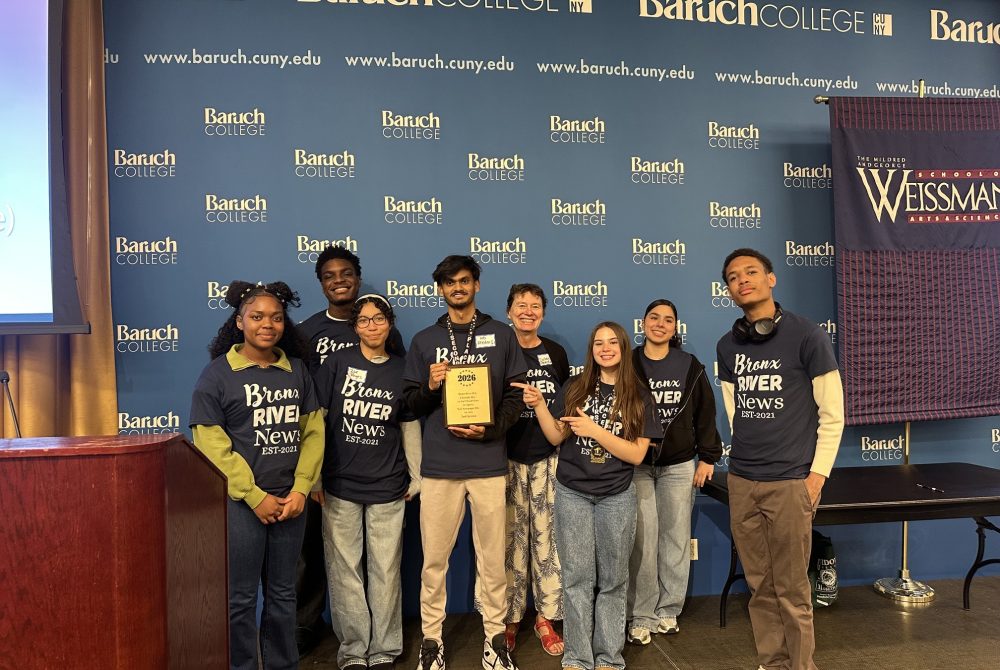
Students at Pace High School in Lower Manhattan reported on the moldering condition of their school’s dilapidated gym in their school paper. Another school newspaper, the Bronx River News, published students’ stories about ICE activity in their neighborhood. Students at other New York schools covered the state’s new ban on cell phones in school, the mayor’s race, violent video games and inconsistent temperatures in classrooms.
These are just a few of the topics that New York City students have written about for their school newspapers, thanks in part to Press Pass NYC. The organization, a fiscally sponsored project of the Fund for the City of New York, works with teachers and students to establish or revive student newspapers in the city’s public schools. In addition to providing resources and learning opportunities for students today, its goal is also to strengthen journalism by seeding and growing the press corps of the future.
It’s not news that journalism is in crisis: Newspapers and national and local media outlets have spent the past few decades facing financial pressure, resulting in layoffs, mergers, and even closures in some cases. A free press may be a sacrosanct American value, but it’s also a value under fire — from corporate leaders focused on the bottom line and billionaire owners looking to insert their own ideological spin, to outright attacks by political leaders.
Meanwhile, the number of school newspapers has also fallen in recent years. In a 2021 survey, the Center for Scholastic Journalism at Kent State University found that just 45% of U.S. public high schools had a student newspaper, down from 64% in 2011. That survey also found that the decline in student newspapers was steepest in disadvantaged and rural areas. An analysis by Baruch College demonstrated that in New York City, high-poverty schools and those with high percentages of Black and Hispanic students are less likely to have student newspapers.
Philanthropy has stepped up its journalism giving as both national and local media outlets face financial and political pressure. Some funders are working to strengthen local news, like those supporting Press Forward, for example. The Racial Equity in Journalism Fund promotes reporting by and for communities of color, and last year, the Knight Foundation made a major commitment to Documented, a news outlet that covers immigrant communities in New York City. Some funders are taking a regional approach to their support for journalism, while others, including the Scripps Howard Foundation and the Knight Foundation, support journalism at the college level.
Press Pass NYC starts further upstream, giving students in middle and high school the opportunity to practice journalism as part of their educational experience. Since it was established in 2021, the organization has enjoyed considerable success. It has partnered with over 40 New York City schools, and will add 16 more this year. The organization’s philanthropic supporters include the Concord Group, the Dow Jones News Fund, the Anita K. Hersh Philanthropic Fund, the New York Times Communities Fund, the Pinkerton Foundation, The Puffin Foundation, UP Foundation and a number of others.
How Press Pass NYC engages teachers and students alike
For Lara Bergen, the founder and CEO of Press Pass, it all started in a remedial Manhattan classroom. Bergen is a teacher, and she was working with students who had to retake English class. To make it more interesting for them, she decided to start a newspaper. The students could pick the topics they wanted to report on — from school events to sneaker options — and she saw some of them becoming engaged in school for the very first time.
“Writing articles about subjects that interested them and working together as a team was a transformative experience both for my students and for me,” Bergen wrote last year in the Hechinger Report. “I knew if I could recreate that opportunity at other schools, I could also duplicate that profound joy so craved by students and teachers.”
Press Pass works with public high schools and middle schools in New York City, with an emphasis on schools with less-advantaged student populations.
It offers free teacher trainings through its Journalism Advisor Fellowship, which provides stipends for participating fellows. Students receive training through the free Student Journalism Leaders Fellowship, and participants receive stipends. Press Pass also offers a free student summer bootcamp, as well as workshops, convenings and a long list of free resources for teachers and students alike.
Early next year, Press Pass will open a student journalism bureau in the Bronx. Schools in that borough have a particularly low number of student newspapers, a fact Press Pass hopes the new bureau will help address. The organization’s student programming currently takes place in Manhattan, at the CUNY Graduate School of Journalism, which is a long after-school commute for Bronx students. Beth Fertig, executive director of Press Pass, hopes that opening a bureau in the Bronx will make it easier for students there to participate. “We see this as a pilot that, if it’s successful, we can replicate in other boroughs,” she said.
Building a pipeline for the next generation of journalists
Journalism builds skills including critical thinking, news literacy, writing, research and collaboration. Press Pass has compiled a list of some of those benefits: High school students who are members of a journalism staff earn higher grades and test scores than their peers, and are more likely to participate in extracurricular activities. Students with journalism experience are also more likely to vote, participate in civics and politics, and become involved in community issues.
There is also a critical benefit for journalism itself: School newspapers help build the pipeline for the next generation of journalists — and people who follow the news in the future. (A 2025 report by the News Literacy Project titled “‘Biased,’ ‘Boring’ and ‘Bad’” found that teens have a dim view of the news media and journalism.)
“Many of our students have never seen a newspaper; we hear this again and again,” said Fertig, who is a journalist herself. “They don’t see newspapers on subways or buses and there are fewer newsstands than there used to be. So for a large number of our students, this is their first experience seeing that there’s a place that you can go that is creating accurate news about your community. And when they write for their school newspaper, they realize that they can become the messengers of information about their school and their community.”
“Why not start with high school?”
The recent uptick in philanthropic funding for journalism, through Press Forward and other funder initiatives, aims to address the current crisis in journalism, helping to fortify and diversify news coverage. Press Pass offers a different approach with a similar goal. But drawing the attention of the funding world hasn’t been easy, according to Fertig. She has found that education funders are primarily focused on initiatives that show direct, K-12 academic results. And funders who want to address the crisis in journalism have their hands full supporting newsrooms and reporters already on the job.
“A lot of funders are putting out fires in news deserts around the country,” she said. “That’s important. But if you want to solve the problem and save journalism, why not start with high school?”
Related Inside Philanthropy Resources:
For Subscribers Only
