


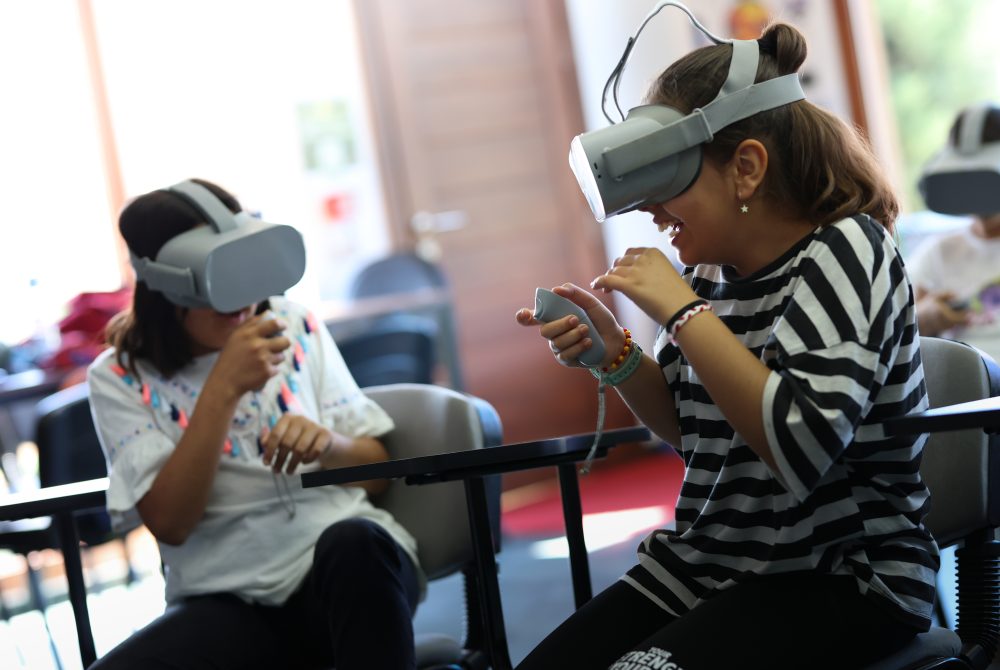
Decades of research have helped us understand how adolescents think, learn and develop. But each generation presents new challenges. Today’s young people are immersed in a digital world engineered to capture and hold their attention, raising new questions about how technology shapes learning and intellectual development. What, exactly, is happening in the adolescent brain in an online era? The Advanced Education Research & Development Fund (AERDF), backed by a new $20 million commitment from Lemnis, is seeking answers.
Established in 2023, Lemnis is a relatively new education funder that was created when the nonprofit Northwest Evaluation Association (NWEA), a developer of K-12 assessments, sold most of its assets to the educational technology company Houghton Mifflin Harcourt. The public charity has deep pockets — close to $950 million in assets at the end of 2024. Its CEO, Melissa Johnston, previously served as NWEA’s chief strategy officer and executive vice president for partnerships, following leadership roles at the Council of Chief State School Officers and Reading is Fundamental.
Focusing on learners between the ages of 10 and 26 — Generations Z and Alpha — Lemnis supports nonprofit and for-profit education enterprises and related research projects: It’s yet another example of a new philanthropic organization set up to fund across the nonprofit/for-profit divide. As my colleague Connie Matthiessen reported, Lemnis operates across three strategies: The Lemnis Collective brings mission-aligned organizations with revenue streams under its umbrella, while the Lemnis Alliance provides grants, primarily through intermediaries and accelerators. Lemnis Initiatives invests in mission-aligned funds and for-profit organizations.
In October 2026, Lemnis announced what Johnston described as “the single largest investment we’ve ever made in our philanthropic portfolio” — a $20 million commitment to AERDF, a nonprofit research and development organization whose major backers include CZI, the Gates Foundation and the Walton Family Foundation. The new commitment will support Neuroscience and the Future of Learning, a four-year initiative investigating how neuroscience and community knowledge can “deepen our understanding of adolescent learning and help translate those insights into learning environments that support young people and strengthen their critical thinking in a rapidly changing digital world.”
Why neuroscience, why now?
When I spoke to Johnston about the project, she was enthusiastic about its exploratory nature. “We are committed to it being open ended,” she said. Sasha Rabkin, AERDF’s chief of program strategy and innovation, offered more detail about how that approach took shape.
Prior to the $20 million commitment, he said, Lemnis funded a landscape study in 2025 that identified neuroscience as an area with considerable potential to advance educational research.
AERDF then assembled a fellowship of six neuroscientists and three education leaders to develop the project’s research agenda and produce a program map that was released alongside the announcement of Lemnis’ commitment. What stood out, according to Rabkin, was “the incredible evolution of neuroscientific capabilities over the last decade” — an evolution that philanthropy has both bolstered and benefited from. Advances in portable technology have made it possible to study brain activity in classrooms and other everyday settings, rather than solely in laboratories. “You can now do neuroscience in a wide variety of places,” he said.
A second theme emerged from the fellowship: AI is raising many important new questions about how young people learn and think. “We’re thinking so much more about things like cognitive offloading and cheating, and thinking much differently about cognition than we might have just a few years ago,” Rabkin said.
Taking brain science beyond the lab
The idea behind Neuroscience and the Future of Learning is to identify aspects of adolescent learning that cannot easily be observed, translate those findings into practical educational strategies, and ultimately improve learning environments.
The first stage involves creating “multimodal labs” that combine portable brain-imaging technology, wearable sensors, classroom observations and students’ own accounts of their experiences. Researchers hope to better understand processes such as attention, motivation and stress as learning takes place. The findings could then inform school design, teacher training and other educational practices, with small grants potentially supporting the testing of ideas in local communities. Ultimately, AERDF hopes to build a shared research infrastructure that allows educators, scientists and communities to develop and apply these insights together.
The agenda is ambitious, particularly because translating brain activity into meaningful measures of learning remains difficult. Portable neuroimaging has opened new possibilities for classroom research, but questions about measurement reliability and practical applications persist. For Rabkin, the opportunity lies in the growing ability to investigate learning as it happens outside the laboratory.
Rabkin emphasized that researchers are still addressing fundamental questions, including whether these technologies can be used effectively in learning environments and “how we provide educators with more information, particularly contextual, individualized information.”
Who shapes the research?
AERDF makes a point of emphasizing the value of community knowledge, but what role will educators and students actually play in setting priorities and determining how discoveries are applied? How will their voices and concerns be incorporated into the project?
“This is a neuroscience and educator-led process,” Rabkin said, referring to the inclusion of education leaders in the fellowship. “It isn’t us saying neuroscientists need to come in and tell educators what to do. In fact, I think it is the cross-pollination and the heterogeneity that is really transformative in terms of what AERDF can provide.”
In terms of students, Rabkin said that in the learning phase, fellows spent time in classrooms, did focus groups, and “bounced ideas off a youth council continually.” AERDF expects to maintain youth and educator advisory groups throughout the program. “It is a core norm for us to include those most affected by the challenge we are trying to solve from the beginning,” he said.
The case for patient capital
Rabkin sees this investment as an opportunity to strengthen independent education research at a time when technology companies and impact investors are spending heavily to develop AI tools. One of AERDF’s anchor funders, CZI, in fact, has shifted most of its education funding toward the development of datasets and tools for product development. Philanthropy may never match those expenditures, Rabkin acknowledged, “but we have to have a counterbalance of insight, research and development for this next era of learning, which is clearly going to be different in so many ways from previous eras.”
That does not rule out eventual product development. AERDF has supported educational products in the past, Rabkin said, but the goal of this initiative is broader: to identify breakthroughs that can make neuroscience useful in learning environments. “Real learners and real problems,” he said, will remain the center of the work.
Rabkin hopes the initiative will encourage more funders to provide the kind of “patient capital” needed for research without obvious or immediate solutions. For now, Lemnis has “set the table,” as he put it, with a sizable investment in a largely unexplored intersection of neuroscience and educational practice. Whether and how that investment produces useful insights for educators and students remains to be seen.
Related Inside Philanthropy Resources:
For Subscribers Only
