


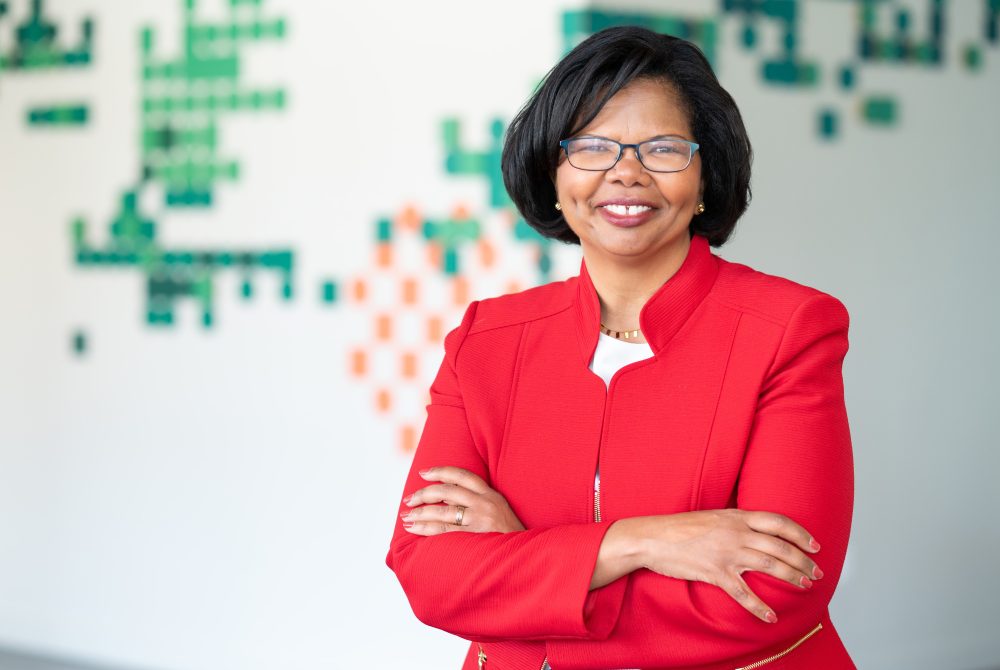
Dale Anglin had been in philanthropy for about five years before she made her first journalism grant as the associate director for programs at Newark, New Jersey’s Victoria Foundation in the early 2010s.
“No one was covering education in Newark at the time, so I gave a small grant for that purpose,” she told me. “That turned into a bigger grant that brought Chalkbeat to Newark, and it’s still there.”
Anglin’s experience presaged her current role as director of Press Forward, the national coalition that launched in September 2023 with a $500 million commitment from funders to strengthen local news, and underscores how the initiative encourages non-journalism funders to support the field. As it noted in a recent impact report, Press Forward invests in local news through three program areas: Its Pooled Fund, created by national donors, which invests in promising ideas; Locals, which is a network of chapters across the country where funders bring new donors and foundations together to expand resources for local news; and Aligned Funding, where funders give directly to local news initiatives.
Since its launch, Press Forward — which IP Editor-in-Chief David Callahan recently cited as an encouraging (and rare) example of philanthropy astutely addressing “shifts in the information landscape” — has rolled out 36 Locals chapters in 29 states and has grown its network of funders from 22 to 88. These funders have invested over $200 million in local news initiatives, with 204 outlets having received funding through the Pooled Fund alone.
Anglin grew up in Chicago, and while she didn’t begin her philanthropic career as a journalism funder, her interest in the field dates back to her childhood. “I came from a family of what I’d call news junkies,” she said. “If the Chicago Sun-Times wasn’t delivered properly, my mom would not be very happy.”
After her tenure at the Victoria Foundation, Anglin was the vice president for proactive grantmaking at the Cleveland Foundation, where she encouraged leaders to invest in a regional network of nonprofit journalism initiatives, including Documenters and Signal Ohio. Anglin joined Press Forward in March 2024. “The job was too hard to pass up,” she said. “It was just a great combination of all of the things I had done, like funding journalism and leading donor collaborations.”
I connected with Anglin to discuss some takeaways from the past year, including how Press Forward works with local donors, what keeps her up at night, and more. The following conversation has been edited for length and clarity.
A big theme in our journalism coverage is that many foundations and donors should be journalism funders, but they don’t know it yet. Can you talk more about this idea?
One of the things that I’ve learned over the last year is how news and information is a cross-cutting issue, and so when we’re engaging any type of funder — high-net-worth individual, local or national — most of them, frankly, don’t come in as journalism funders. They come in funding everything else, and then you start talking about how important news is to the work that they are trying to accomplish. Probably three-fourths of the foundations that we now have in our midst either did not fund journalism at all [or] didn’t have a news and information strategy.
So how does Press Forward engage these non-journalism funders?
We work a little differently with national funders versus our local funders. For national funders, we put out the call early on, before I was even hired. Some funders came on because [funding partner MacArthur Foundation President] John Palfrey asked them to come on. Since I’ve been hired, we spend a lot of time at foundation conferences so we can get the word out and help people understand how news can be related to whatever issue that they’re funding.
How do these conversations play out in the Locals chapters?
For our Locals chapters, we have people who are interested in a specific issue, so we ask them how journalism can help them accomplish what they want to do about that issue. We’ll have lots of conversations before a chapter becomes a chapter or a local donor decides to join us.
One thing I’ve learned from being in philanthropy is, you’ve seen one foundation, you’ve seen one foundation. You have to figure out ways to customize your work with them. The question is, do they have the money to support it? Do they have a program officer or somebody who can devote time to this? And so we’re working with our partners to train funders, because again, so many of them are not journalism funders.
How do high-net-worth individuals fit into the mix?
We have a few of them already in our midst, but we’ve started to spend more time recruiting them. We have a new partnership with a group of high-net-worth individuals called Forward Global. We just spoke at their conference and we got people to donate. So we’re trying to make sure we approach funders with and without staff.
High-net-worth individuals are such a fascinating group because fundraisers are always trying to figure out what makes them tick. At the expense of asking you to don your psychologist hat, what are some of the strategies that have been effective in making them see the value of journalism?
I’d say we’re just beginning this process. I got to meet a lot of them three weeks ago, and we’ve already developed toolkits for our chapters to help them engage these donors.
When it comes to the issues, individual donors care about our democracy, attacks on the press, misinformation and disinformation. Sometimes, individual donors want a lot more attention, and so they want to talk with you and the grantees. Just last week, someone called and said, “You guys seem to know what you’re doing. I’m going to give $50,000 to the Pooled Fund.” But that’s just one person.
We had another donor who didn’t want to give to the Pooled Fund. She cared a lot about Florida, and I put her in touch with that chapter, and they’re going to be working together. If she gives money, she’s going to give to that chapter, which is fine, right? We don’t care where the money goes, as long as it gets into the system that supports news.
We’ll be learning through Forward Global about, what are the best ways to talk to high-net-worth individuals, and how to develop a customizable approach toward managing them, because it’s just a different type of fundraising and engagement compared to working with a staffed foundation.
Not to put too fine a point on it, but let’s say I’m a Locals chapter. What does my engagement with donors look like on a practical level?
I’ll give you an example. In Iowa, Community Foundation of Greater Dubuque President and CEO Nancy Van Milligen runs one of our Locals chapters, and she created multiple funds. She’s got an endowment fund, an immediate use fund, so funds come in and go right back out. She’s got a fund focused on young reporters and interns, because she knows some donors who care about that side of the system.
Nancy gives this great speech about how, in the first six months, she’d say to donors, “Woe is us in journalism. It’s horrible what’s happening in the field.” Donors don’t want to hear that. When she instead says, “Here’s a bright spot, here’s an example that we could replicate here,” then all of a sudden she gets money. She’s learning in real time to change her messaging. And then she’s sharing that out with our other chapters so that they can replicate that.
It sounds like engaging with community foundations is a huge part of this process because these are the folks that have access to high-net-worth donors with donor-advised fund accounts.
That’s right. Let’s be clear: Press Forward was designed to get people to give money. So you start with community foundations. You don’t start with private foundations. They’re not raising money. Now, we include them, of course, and a lot of them are partners, but our bailiwick is starting with community foundations because they know how to raise money and they have a set group of people that they can start with.
You had extensive experience in journalism philanthropy before joining Press Forward. That said, has anything about your tenure surprised you so far?
I spend a lot of my time with folks in both philanthropy and journalism. And while I already knew it during my time in Ohio, it’s become even more clear to me that these two industries need to understand each other better.
Previously, philanthropy did not need to understand journalism because they didn’t fund it very much. And the industry didn’t need philanthropy because they had other revenue sources. Well, now we’re at a place where they need each other.
Philanthropy needs journalism to accomplish some of the things it wants to accomplish. It can’t just assume local news is there to talk about what they want to talk about. On the other hand, the industry also has to understand how philanthropy works — and it doesn’t work as fast as you might want it to.
Related Inside Philanthropy Resources:
For Subscribers Only
It’s as if those two worlds have been walled off from each other.
I’ve had multiple conversations over the last year with lovely journalists, publishers, editors and reporters who say to me, “I had a meeting with a funder and it didn’t go well.” I’d ask them, “Well, how did you approach it? What was the message that you gave?” And it became clear that they just assumed philanthropy understood what they did and how they work. But philanthropy usually understands none of those things.
On the other hand, I’ve had leaders at foundations — usually smaller ones — come to me and say, “I don’t really know much about journalism,” or “An outlet was calling me, but I didn’t call them back.” And I’d said, “Why? What if that was a homelessness group? You would call them. What’s the difference with the outlet?” And they just said, “I don’t know.” It’s because they’ve never done it before.
As much as I’d love to dwell on the encouraging stuff, now, I feel obligated to ask that clichéd question of what keeps you up at night.
We’re stopping the bleeding in some places. We had our first open call [on closing coverage gaps] and now we’re getting out to meet the grantees and hear their stories about how they have managed to hang on in all sorts of ways, so we’re not losing the battle.
It’s just that, is it enough? Because we’re still losing outlets, and let’s be clear where we’re losing them — places where there is low economic development and low economic resources in general. They’re entwined. So one of the things that keeps me up at night is, can we move fast enough? And, you know, you study philanthropy — we’re not known for being the fastest.
It’s not the most comforting analogy, but someone once said to me that change in philanthropy is like trying to turn around the Titanic.
Which is why we’re going after high-net-worth individuals who can move faster.
What advice would you give nonprofit readers looking to engage funders in this climate?
I would say a few things. First, no matter what kind of outlet you are, you have to tell your story of impact. Good nonprofits don’t just talk about how they do their work; they talk about the results of their work.
That’s not how outlets normally went about doing things. They’d just say, “I did 10 stories on topic X.” Maybe an investigative piece led to someone’s downfall, but most often, it’s just the fact that you wrote the story that was important. For philanthropy to support the field, that isn’t going to be enough.
Also talk about your collaborations. We now have many more examples where disparate groups work together — a radio station and a college newsroom, or a small paper working with a big paper. Philanthropy loves to see that type of collaboration because while they’ve seen it work really well in other industries, they’re not used to it in news.
Lastly, I would say to know your audience. There are so many other things they could be reading or watching, so it’s important to understand them, and then give them a service. Over the next couple of years, we’re going to help editors and journalists build their muscle to do that.
Speaking of which, is there anything else coming down the pike our readers should know about?
Right now, we’re in the middle of our second open call, on infrastructure. It’s about how we can provide opportunities to bolster the entire industry and not just one outlet. We ended up receiving over 500 submissions, and we’ve narrowed them down to a set of finalists, and from that group, we plan to invest in 20 to 30 projects with grants up to $1.5 million over three years. We’ll be announcing the winners in June.
We’ll also be doing a big strategic communications research project to think through what words work in different communities. People have different definitions of “news” and “journalism.” When you ask a foundation why they joined Press Forward, they’ll say, “I care about journalism” or “I care about democracy.” Those are two different things. So we want to look at what words work in our localities that will convince people of the need to support local news.
We’ll use the findings for fundraising, but we’ll be sharing it out with journalists and outlets, too. We’re never going to assume that everybody’s going to join Press Forward. I’ve already had foundations say, “I’m not going to join; I’m not a joiner.” I said, “That’s fine. But are you giving more money to local news? You are? OK, then I’m good.” Because that’s the goal here — more money for local news.
